
Player Journey Map for Mobile Games: How to Turn the Player Path into a Monetization Tool
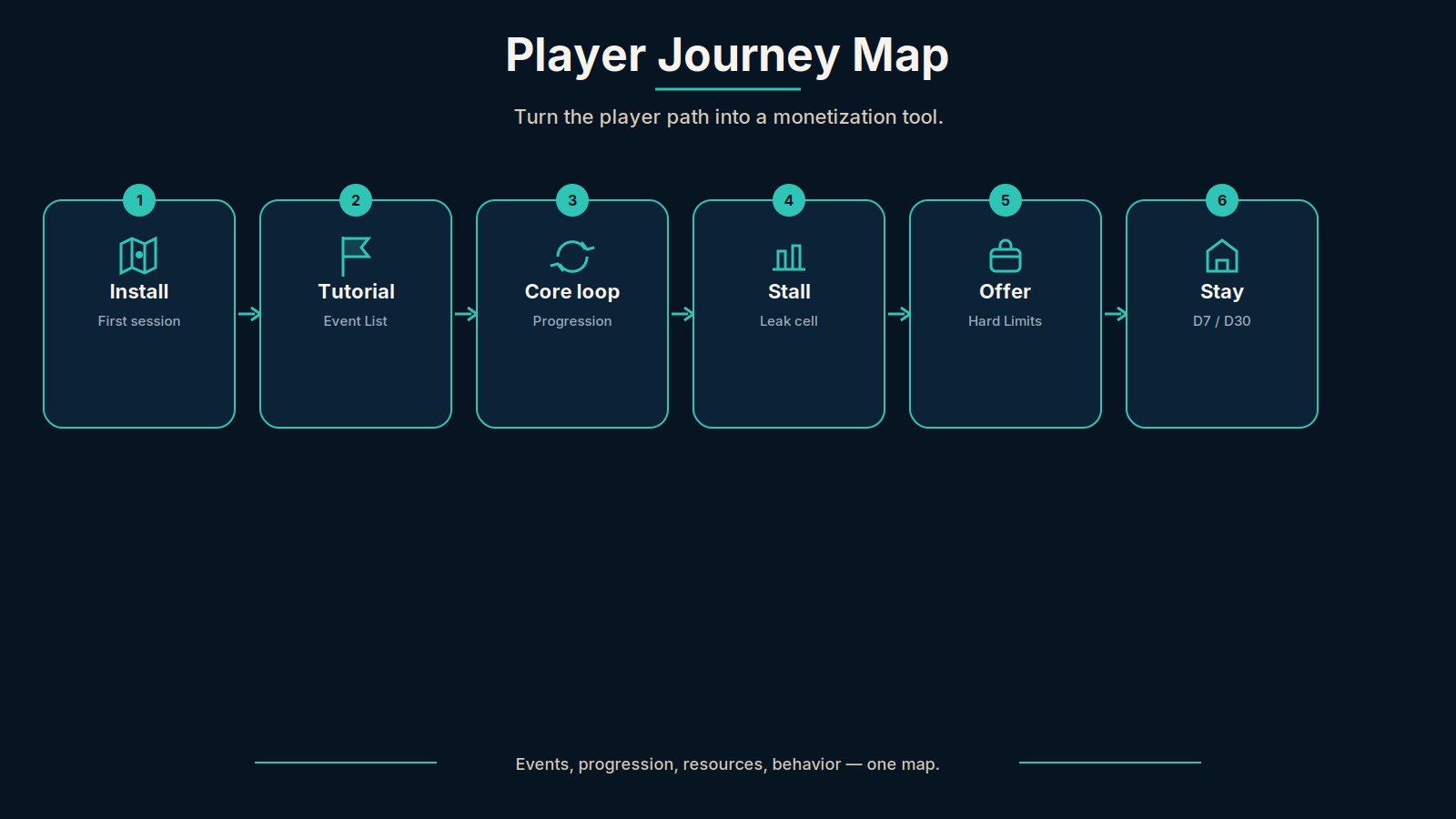
Most studios already have a funnel slide. Few have a Player Journey Map (PJM) that a producer can use to place an offer, an analyst can use to name a leak, and a CTO can instrument without rewriting combat. A pretty path with five emoji is not a monetization tool. A timeline where events, progression, resources, and behavior sit on the same axis is.
Get sandboxThis is a practical guide for the CTO who owns the Event List, the analyst who owns the cut, and the producer who owns Hard Limits. You leave with a four-layer map, a table of leak moments, a role split, and a checklist you can print before anyone talks about “AI offers.” Timelines and floors below are site claims from mone.tools, not a promise for your title.
Do not treat unnamed genre cards or marketing percentages as proven results. The map is an instrument. The A/B test is the verdict.
What a Player Journey Map actually is
A PJM is not a substitute for a dashboard and not a redesign of the meta. MONE describes a closed loop: collect data → read behavior and segments on Player Journey Maps → issue an offer and a spot inside designer rules → calibrate in an isolated A/B test. The map is the second step. Without it, personalization is a discount bot with a confidence score.
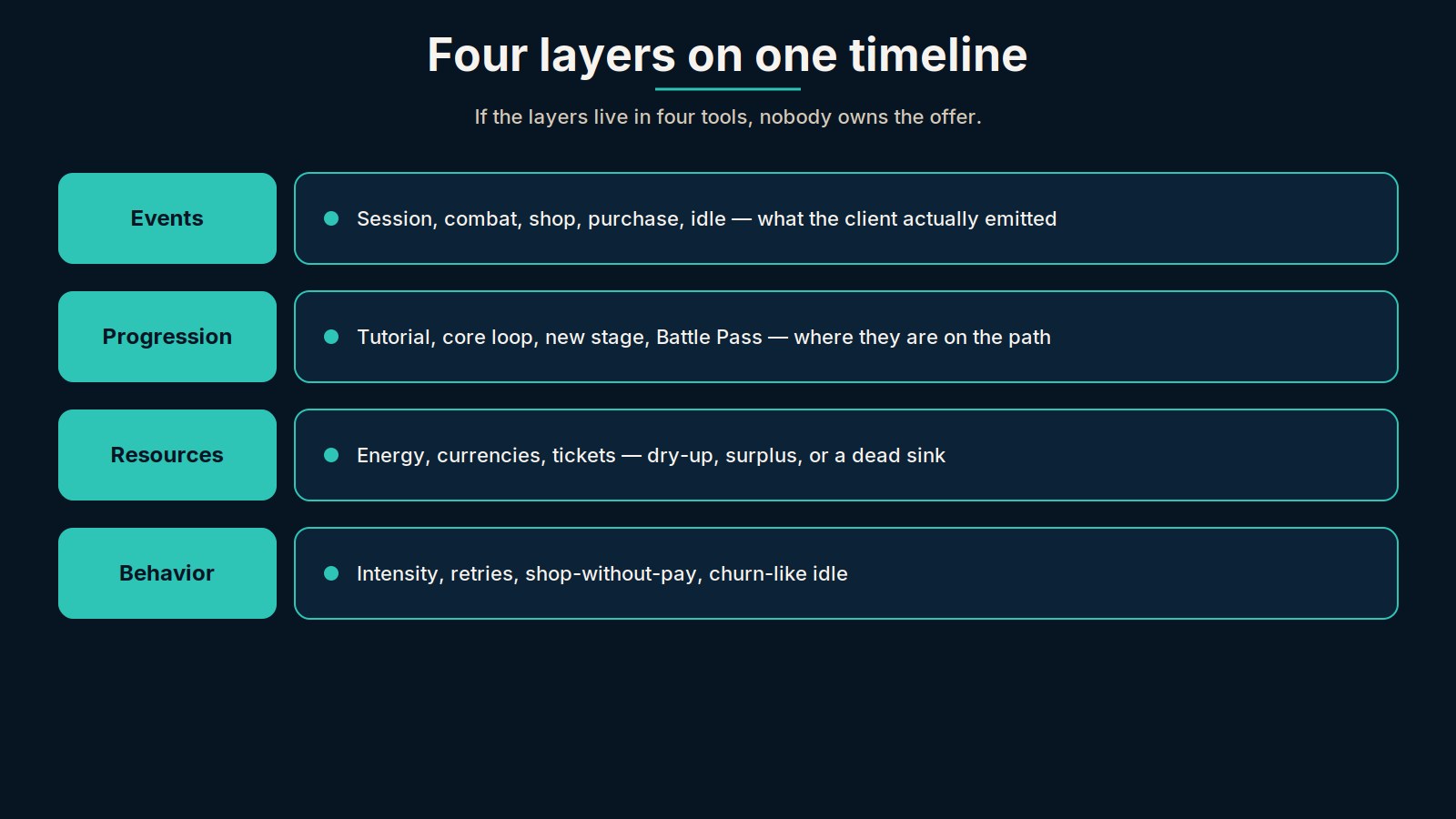
On one timeline you need four layers, not four separate reports:
- Events. What the client actually emitted: session start, tutorial exit, combat result, purchase, idle. Garbage here becomes confident nonsense later.
- Progression. Where the player is in the designed path: tutorial, early core loop, new stage, endgame, Battle Pass track.
- Resources. What they can spend or are missing: energy, soft, hard, tickets, lives — and how close they are to a dry-up.
- Behavior. How they play, not only what they bought: intensity, churn-like idle, retry after defeat, shop open without purchase.
The site’s public pipeline puts PJM next to segments (Engaged Free through Whales) after a historical SandBox pass, before SDK. Site claim: SandBox in 1–2 hours at the audit step, then telemetry in 1–2 days once you connect. Connecting SandBox takes several hours; full personalization connection is less than a week (site claim). Do not merge those clocks with “Sandbox in 48 hours” on the hero — that is a different stage.
Minimum for an ML personalization pilot on the site: 5,000 unique players per month. Below that, still build the historical map. A thin dump still beats a slide with no events.
Four layers on one timeline
If the four layers live in four tools, nobody owns the offer. The analyst sees a drop-off. The designer sees a difficulty spike. The monetization lead sees a shop SKU. The CTO sees an event that never fired. The PJM is the joint artifact: one player-state at a time, readable in a week, versioned like a spec.
| Layer | What you plot | Monetization use |
|---|---|---|
| Events | Session, combat, shop, purchase, idle, tutorial exit | Can we fire a trigger here without a new UI? |
| Progression | Stage, quest, Battle Pass, new content gate | Is the offer a skip, a bundle, or a wait? |
| Resources | Energy, currencies, tickets, inventory depth | Is this a dry-up, a surplus, or a dead sink? |
| Behavior | Intensity, retries, shop-without-pay, churn-like idle | Is the player stuck, bored, or about to leave? |
Events: the CTO’s contract
The Event List is the map’s source of truth. Site claim: 200+ computed events, not “log everything raw.” Supported engines: Unity, Unreal Engine, Godot, custom studio engines. Platforms: iOS, Android, Web.
CTO work on this layer:
- Map existing telemetry onto the Event List. Do not invent five vanity events for a slide.
- Guarantee session, purchase, resource, and failure events survive a client resubmit.
- Expose offer surfaces you already have. A PJM that points at a pop-up you will not ship is fiction.
- Fallback: if personalization is silent, the player sees the live default shop.
MONE states its team can take SDK integration. That does not remove studio ownership of the dictionary, QA, or store submit. Site claim: telemetry in 1–2 days, then personalization launch in 2–3 days once Hard Limits and cohorts exist. Store review and consent can add time the marketing page does not show.
Progression, resources, behavior: the analyst’s cut
Progression without resources is a walkthrough. Resources without behavior is a balance sheet. Behavior without events is an anecdote.
Demand from the first PJM, whether you use MONE or another vendor:
- Segment transitions, not only a payer / non-payer split. The site talks in Engaged Free → Whales; keep that axis even if you add new vs returning.
- Economy bottlenecks and dead sinks on the same lane as stage gates.
- Drop-off moments with a timestamp and a last event, not a blended D1 number.
- Offer spots that already exist (defeat, resource dry-up, upgrade complete, new stage) versus spots that would need new UI.
Analytics on the site is priced at 0 $: raw-data audit, static SandBox, SDK, real-time, 200+ events, signals into MMP. Treat that as a commercial posture. Still run your own data-quality review before you trust a cell on the map.
Where the path leaks revenue
A leak is not “ARPU is low.” A leak is a place on the map where the designed path and the live shop disagree. Typical cells:
- The player stalls on a gate the designer called fair, then sees the same generic pack as a Whale.
- Energy hits zero in an engaged session; the shop shows a cosmetics SKU.
- Tutorial exit has no event, so the map is blank for the cohort that never reached the core loop.
- Repeat purchase is dead because the first-purchase bundle emptied the only sink that felt urgent.
Drop-off is not the same as dry-up
Drop-off: the player leaves a stage or the session. Dry-up: they stay, but cannot spend. Monetization that treats both as “show a 70% discount” trains irritation. Retention-First, as named on the site, is supposed to block a show that risks LTV or churn. That rule is meaningless unless the map can tell those two cells apart.
Plot, at least:
- Last progression event before idle.
- Resource delta across the session, not only wallet at purchase.
- Retry count after defeat. A player who retries is not the same as a player who opens the shop and closes it.
- Time-to-next-stage versus time-to-next-offer. If offers arrive faster than content, you are not personalizing. You are nagging.
Identical shop for everyone is a map finding, not a philosophy
If Engaged Free and Whales see the same SKU at the same spot, the PJM should say so in one row. That is the cheapest personalization case: composition, discount, and price may move with ability to pay, progress, and session context — Dynamic Pricing as a mechanism, not a separate product — and they may not move past Hard Limits.
If the map cannot show that mismatch, you are not ready to “turn on ML.” You are ready to fix instrumentation.
From map cells to offer decisions
The map earns its keep when a cell becomes a decision: show, wait, or never. Smart Triggers, as named on the site, pick the spot where conversion probability is high and irritation is low. That is a hypothesis about timing. Your test still has to show that extra shows did not buy ARPU with D7.
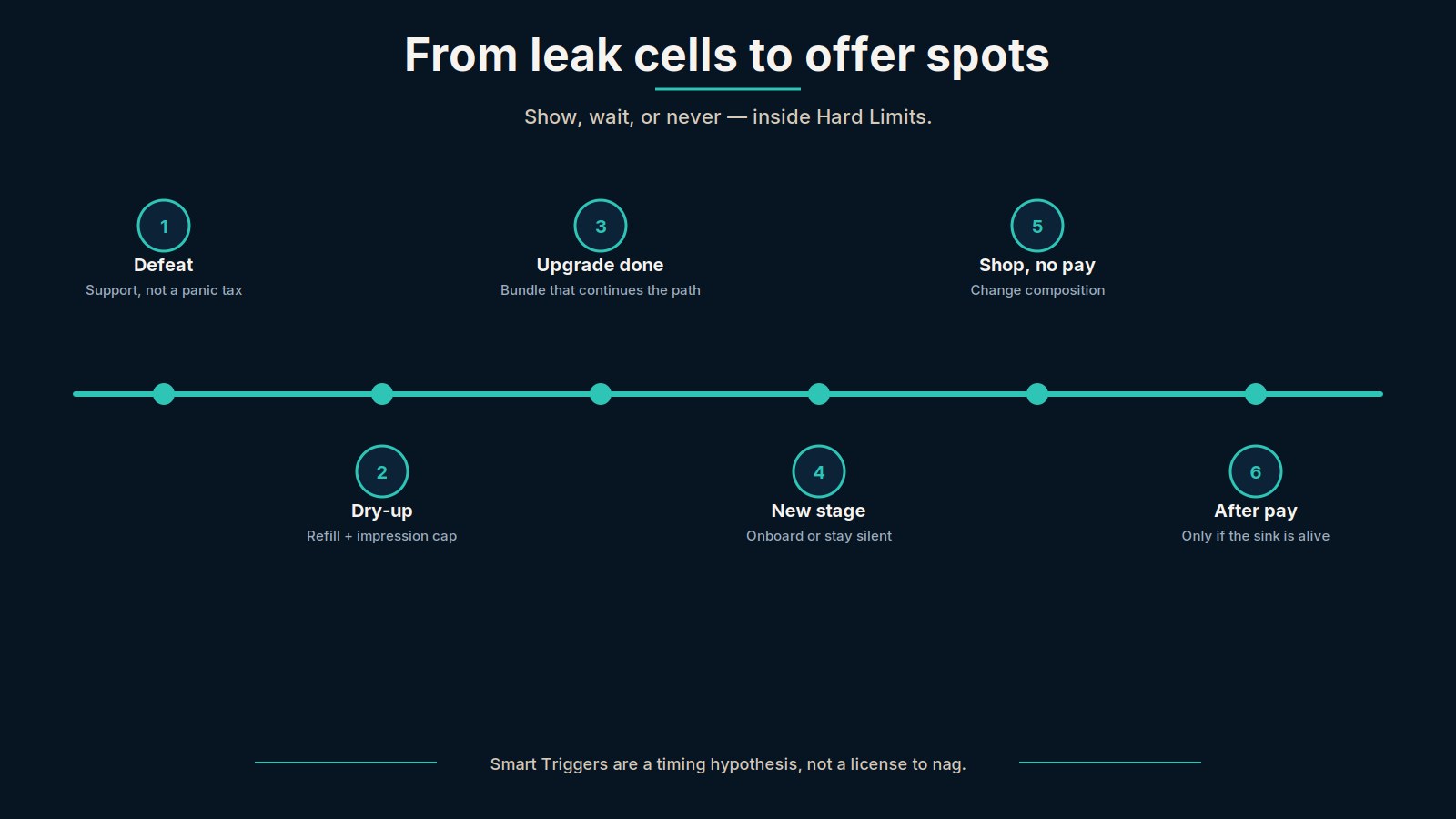
| Moment | What the map must show | Offer decision inside the corridor |
|---|---|---|
| Defeat / retry | Fail streak, remaining resources, stage | Support pack or wait; never a panic tax |
| Energy / resource dry-up | Session still active, sink is the blocker | Refill in Hard Limits; cap impressions |
| Upgrade complete | Next gate cost vs wallet | Bundle that continues the path, not a detour cosmetic |
| New stage / content gate | First session on the stage, no purchase yet | Onboarding offer or silence if Retention-First fires |
| Shop open, no pay | Repeat opens, no 1st Pay Conv. | Change composition; do not add a second pop-up |
| Post-purchase | Repeat-purchase lag, leftover currency | Second offer only if the sink is still alive |
Corridor before model
Hard Limits, Impression Caps, white/black lists, and Fallback are the product. A PJM that recommends an offer the producer did not sign is a design leak, not an insight.
Producer signs before the first dynamic offer:
- Price ceilings and item stop-lists.
- Impression Caps per player and per session.
- Retention-First: block a show if it risks LTV or churn.
- Priority so two eligible offers cannot fight in the same spot.
- Versioning: who may publish, and how fast you roll back.
If those rules are unsigned, you do not have a monetization map. You have a heatmap of where a bot would shout.
Site claim for the learning window after you do connect: week 1 trains profiles; weeks 2–4 run automatic delivery; evaluation is a separate 3–5 days. Book the readout before you book the launch party. Primary formula later:
ARPU_uplift = (ARPU_test − ARPU_control) / ARPU_control
Guardrails: Retention D7/D30. Hypothesis, not a guarantee: personalization can raise ARPU if the control shop is mismatched to at least one large segment, the new offer sits inside Hard Limits, and Smart Triggers do not flood impressions. If any of those is false, expected uplift is zero — which, on MONE’s published model, is also a 0 $ personalization bill.
How to draw the first map in one sitting
Do not wait for a perfect warehouse. A working PJM for a pilot is a workshop artifact, then a cleaned cut.
Ninety minutes, three roles in the room:
- Minutes 0–15. CTO puts the Event List on the wall: what fires today, what is missing, what would take a client resubmit. If session, purchase, fail, and resource events are absent, stop and instrument. The map cannot invent them.
- Minutes 15–45. Analyst walks one real cohort along the four layers — not a blended MAU line. Mark stall, dry-up, shop-without-pay, and tutorial blank. Write cells as sentences: “Engaged Free hits energy zero in an active session and sees cosmetics.”
- Minutes 45–75. Producer tags each cell show / wait / never and names the existing UI surface. If the cell needs a new pop-up, it is out of the pilot.
- Minutes 75–90. Sign Hard Limits or book the meeting that will. Without a corridor, the map is a mural.
Export the board into the same document you will put next to the SandBox report. Version it. The next cycle starts from this file, not from a new slide.
Site claim: SandBox can draw a first PJM from six months of history without SDK. Use that if the workshop dump is thin. Still run the ninety minutes — the vendor picture is a draft until the three roles argue with it.
Who owns the map
A PJM dies when “the vendor will color the arrows” and nobody in the studio can name the rollback owner. Use this split. R = responsible for the work, A = accountable for the decision, C = consulted, I = informed.
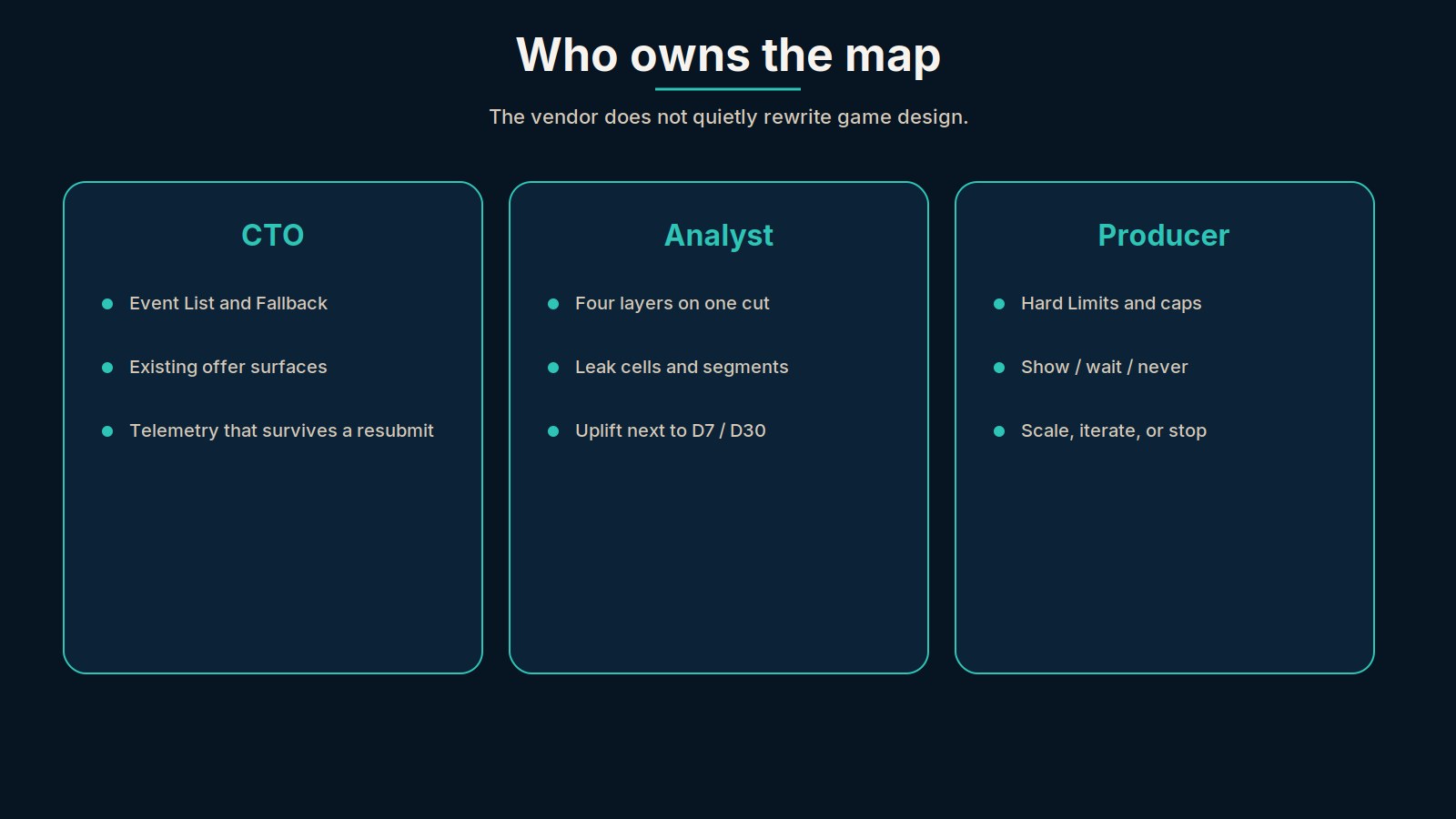
| Role | Developer / CTO | Analyst | Producer | Solution vendor |
|---|---|---|---|---|
| Event List & telemetry | R (instrument, QA, Fallback) | C (dictionary) | A (store/consent dates) | R or C (SDK; MONE may staff this) |
| Layer definitions | C (what the client can emit) | R (events × progression × resources × behavior) | A (what “stuck” means in this title) | C (comparable PJM cuts) |
| Leak readout | I | R (cells, segments, uncertainty) | A (which leaks are in scope) | R (first SandBox PJM) |
| Offer spots | R (existing surfaces only) | C (conversion vs irritation) | A (Hard Limits, caps) | R (Smart Triggers inside rules) |
| A/B & scale memo | C (assignment, rollback) | R (uplift + D7/D30) | A (scale / iterate / stop) | R (report; no unmarked genre %) |
Checklist (print this)
- Four layers named on one page: events, progression, resources, behavior. No layer lives only in a private dashboard.
- Event List mapped; session, purchase, fail, resource, idle survive a build; Fallback tested.
- Segments at least along Engaged Free → Whales, plus new vs returning if you have the events.
- Existing offer spots listed. No pilot depends on a pop-up that is not in the client.
- Hard Limits, Impression Caps, Retention-First, white/black lists signed.
- Leak cells written as decisions: show / wait / never — not as “the model will know.”
- Baseline pack exists if you will test: ARPU/LTV, 1st Pay Conv., D7/D30, window, denominator.
- Traffic at or above 5,000 unique players / month for an ML pilot, or the cycle is explicitly “map and audit only.”
- Week-5 decision meeting booked before week-1 launch, if you connect.
Key takeaways
- A Player Journey Map is four layers on one timeline. Events, progression, resources, behavior. A funnel screenshot is not a map.
- The CTO owns instrumentation and Fallback. The analyst owns the cut. The producer owns the corridor. The vendor does not quietly rewrite game design.
- Leaks are cells: stall, dry-up, identical shop, dead repeat purchase. Name the cell before you name the model.
- Offers come from signed spots inside Hard Limits. Smart Triggers without a corridor are not personalization you can scale.
- The map is an input to one experimental cycle, not a replacement for it. SandBox can draw the first PJM on history; scale still needs an A/B memo.
Request a SandBox, not a license
If you have roughly six months of events and a producer who can lock a corridor, the next step is a historical audit: segments, PJM, leaks, and a report you can hold next to your current stack. Start at the MONE audit / SandBox path or the pipeline. Studio console: dash.mone.tools. Analytics is the free layer; personalization billing, on the site, starts only after an A/B test confirms ARPU uplift.
Read also
- From audit to scale: monetization personalization in one cycle
- How to find hidden revenue leaks in a mobile game (audit from A to Z)
- When to show an offer: ten live situations where a proposal can be appropriate
- How to keep control of the game economy when you use AI