
How to Keep Control of the Game Economy When You Use AI

The objection sounds almost the same on every call with a CTO and a producer: “If the model sets the price, it will break the economy.” That is rarely fear of the algorithm. It is the absence of a corridor. AI that may show any SKU at any discount at any moment is not personalization. It is a fire-sale bot with a confidence score.
Get sandboxThis is a MOFU objection-handling piece for the CTO, Lead Data Analyst, and producer who already look at the pipeline but will not sign a pilot until they see the levers. You leave with a control map: prices, discount limits, white/black lists, frequency, Fallback, and rollback. Timelines and floors below are site claims from mone.tools, not a promise for your title. Do not treat unnamed genre cards as proven results.
What “control” actually means
Control is not turning the model off. MONE describes a closed loop: collect data → read behavior on Player Journey Maps → issue an offer and a spot inside designer rules → calibrate in an isolated A/B test. “Inside designer rules” is product, not a footnote. The model proposes mix, price, and moment. The studio decides what may be shown at all.
If the corridor is unsigned, the objection “AI will break the economy” is correct. The model optimizes what you gave it. If you gave it an empty shop and a KPI of “conversion at any cost,” it will find a 70% discount on a gate the designer called fair.
The site’s public pipeline puts the Management Console and Hard Limits next to offer issuance, not after an incident. Site claim: SandBox in 1–2 hours at the audit step, telemetry in 1–2 days, personalization launch in 2–3 days once Hard Limits and cohorts exist. Full personalization connection is less than a week (site claim). Those hours do not replace the meeting where the producer signs the caps.
Minimum for an ML personalization pilot on the site: 5,000 unique players per month. Below that floor, still write the corridor on paper. Rules without traffic beat a model without rules.
Four levers the model is not allowed to bypass
The four levers live in one place — a console the producer can read, not a data scientist’s notebook. Otherwise “control” exists only on a slide.
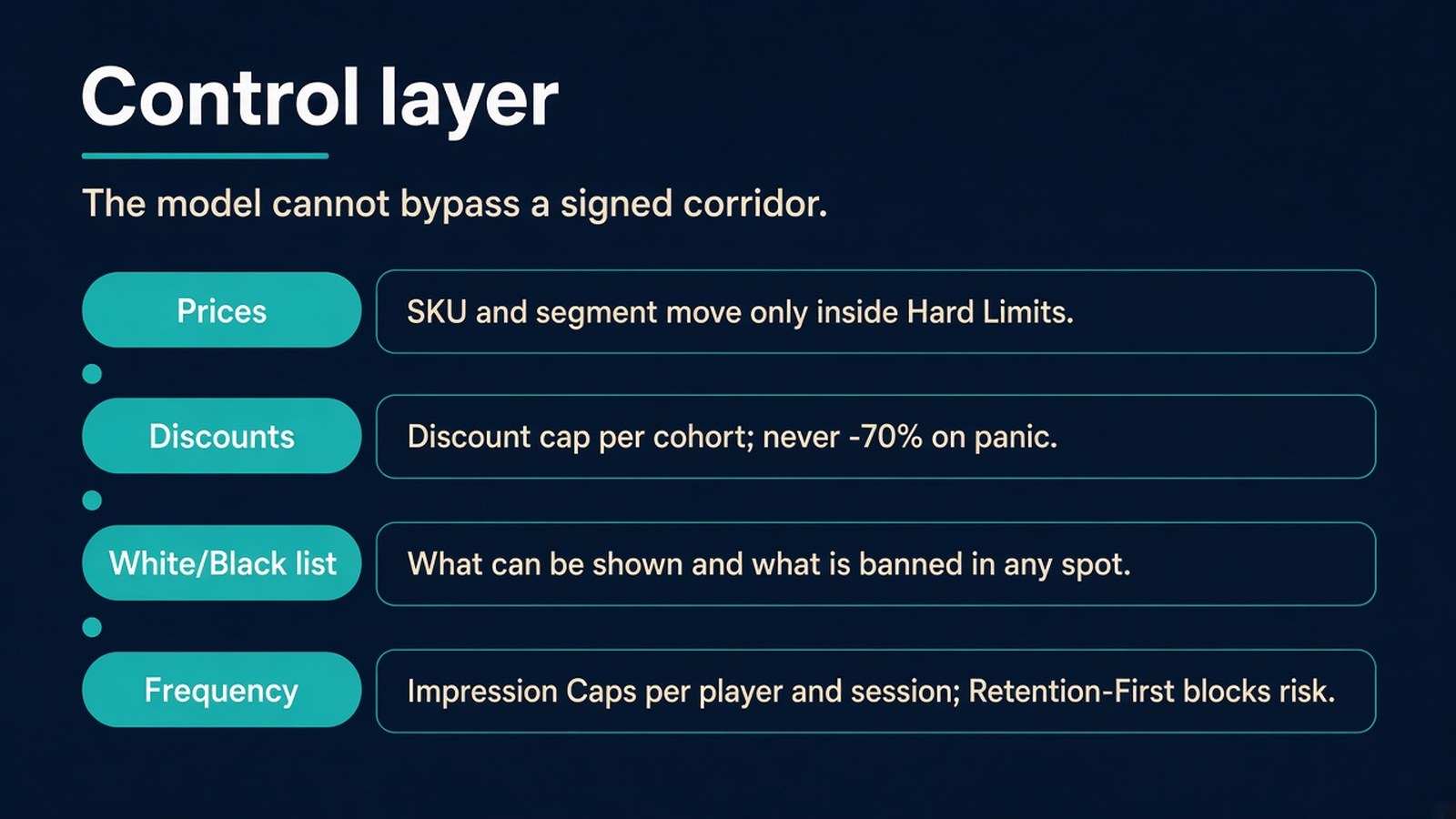
| Lever | What you lock before the pilot | What breaks without it |
|---|---|---|
| Prices | SKU × segment range inside Hard Limits | The model moves price as an unnamed discount |
| Discount limits | % cap and absolute floor per cohort | Panic after defeat buys ARPU with D7 |
| White / black list | What may be shown and what is banned in any spot | Cosmetics on a dry-up, a booster on a fair gate |
| Frequency | Impression Caps per player and per session | Smart Triggers become spam |
Prices are not “dynamic on everything”
Dynamic Pricing on the site is a mechanism inside the corridor, not a separate product that may rewrite the price list. Price may move with willingness to pay, progress, and session context. It may not leave the Hard Limits economy signed as balance.
Demand before the first dynamic offer:
- The list of SKUs that participate in personalization at all. Everything else is a black list by default.
- A price range per SKU: min / base / max. Not “the model will pick.”
- A ban on moving the price of a core combat pack if that breaks the stage sink.
- A rule for Whales vs Engaged Free: different caps, one SKU dictionary.
If there is no range, you do not have a pricing policy. You have an A/B on chaos.
Discounts are a cap, not the model’s personality
A discount is the cheapest way to “prove” personalization and the fastest way to teach players to wait for −70%. Retention-First, as named on the site, must block a show that risks LTV or churn. The rule is meaningless until a discount cap is signed per cohort.
Lock:
- A maximum discount % for Engaged Free, mid, and Whale — different numbers.
- An absolute price floor the SKU never crosses even at a high score.
- A ban on panic discounts: a fail streak is not a sale trigger.
- Offer duration. A perpetual “personal” coupon is a new price list.
Monetization that treats both churn and dry-up with the same discount teaches irritation. The journey map distinguishes the cells; the corridor forbids the same answer.
White/black lists and frequency: what may be shown, and how often
A white list is not “pretty cards in admin.” It is the finite set of offers the producer is willing to see in production. A black list is items, spots, and segments the model never enters: the start of tutorial if exit is uninstrumented; a fair difficulty gate; a SKU that breaks the Battle Pass.
Frequency is a separate lever. Smart Triggers, as named on the site, pick a spot where conversion probability is high and irritation is low. Without Impression Caps that is a hypothesis about greed.
| Rule | Producer question | Stop if… |
|---|---|---|
| White list | Which offers can be assembled from the live shop? | The list is empty or depends on a pop-up that is not in the client |
| Black list | Where does the model never go? | The ban lives in Slack, not in the console |
| Session cap | How many shows in a live session? | A second pop-up after a closed shop |
| Player cap | How many per day / week per person? | D7 falls while “personalization” grows impression count |
| Retention-First | When is a show banned even at a high score? | Nobody can say “never” |
| Priority | What if two offers fit one spot? | They fight and both ship |
Surface first, model second
A PJM that recommends an offer on a pop-up that is not in the client is a design hole. The same is true of the white list: if a SKU cannot be assembled from the existing shop, it is out of the pilot.
CTO work on this layer:
- Fallback: if personalization is silent or the corridor cuts the offer, the player sees the live default shop — not a blank screen and not an “offer error.”
- Session, purchase, fail, and resource events survive a client resubmit. Otherwise caps count air.
- Do not give the model new UI. The pilot sits on surfaces that already passed the store.
MONE states its team can take SDK integration. That does not remove studio ownership of the dictionary, QA, or the corridor signature. Site claim: telemetry in 1–2 days, then personalization launch in 2–3 days once Hard Limits and cohorts exist. Store review and consent can add time the marketing page does not show.
Fallback and rollback are product, not a runbook in chat
The objection “what if the model goes off the rails” is not closed by trust in the vendor. It is closed by two buttons the studio presses itself.
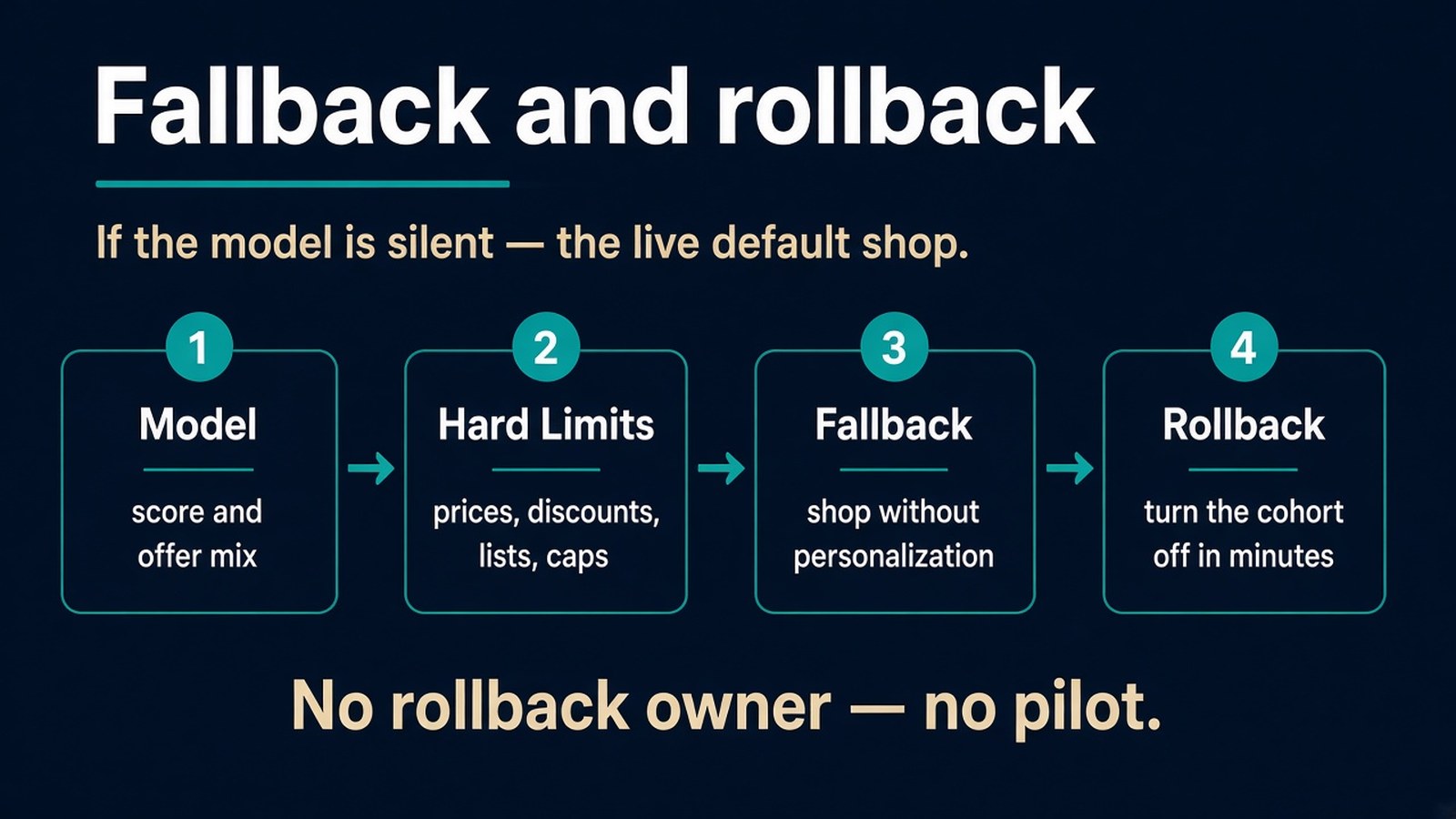
Fallback is silence behavior: no score, no fresh events, the corridor cut the offer, the service is down. The player always sees a valid shop. Rollback is turning personalization off for a cohort, a segment, or the whole pilot in minutes, without a client resubmit and without “wait for the pipeline.”
If rollback needs a build, you do not have rollback. You have a release.
The producer signs before the first dynamic offer:
- Price Hard Limits and item stop-lists.
- Impression Caps per player and per session.
- Retention-First: block a show if there is risk to LTV or churn.
- Priority so two matching offers do not fight in one spot.
- Versioning: who publishes the config and how fast you roll back.
- The name of the person who hits Rollback on a Saturday. Not “the ML team.”
Site claim on the learning window after connect: week 1 trains profiles; weeks 2–4 automatic issuance; evaluation is a separate 3–5 days. Book the readout before the launch party. The headline formula later:
ARPU_uplift = (ARPU_test − ARPU_control) / ARPU_control
Guardrails: Retention D7/D30. Hypothesis, not a guarantee: personalization can lift ARPU if the control shop mismatches at least one large segment, the new offer sits inside Hard Limits, and Smart Triggers do not flood impressions. If any of that is false, expected lift is zero, and under MONE’s published model the personalization invoice is also $0.
How to sign the corridor in one sitting
Do not wait for a perfect model. A working corridor for a pilot is a workshop artifact, then a config in the console.
Ninety minutes, four roles in the room:
- Minutes 0–20. Economy puts the pilot SKUs and min / base / max ranges on the wall. If the answer is “the model will pick” — stop. There is no pricing policy.
- Minutes 20–40. LiveOps fills the white list from the live shop and the black list of spots the model never enters: tutorial without an exit event, a fair gate, a Battle Pass SKU. An empty white list — stop.
- Minutes 40–65. The producer sets Impression Caps, Retention-First, and discount caps per cohort. Panic after defeat does not get a special discount “because the score is high.”
- Minutes 65–90. The CTO shows Fallback (silence → live shop) and rollback without a resubmit. They name the on-call. If rollback is “the next release,” there is no pilot.
Export the board into the same document that will sit next to the SandBox report. Version it. The next cycle starts from this file, not from a new “AI offers” slide.
Site claim: SandBox can draw a first PJM from six months of history without SDK. Use that to see where the corridor is still leaky. Still run the ninety minutes — the vendor picture is a draft until the four roles argue with it.
Who owns the rules
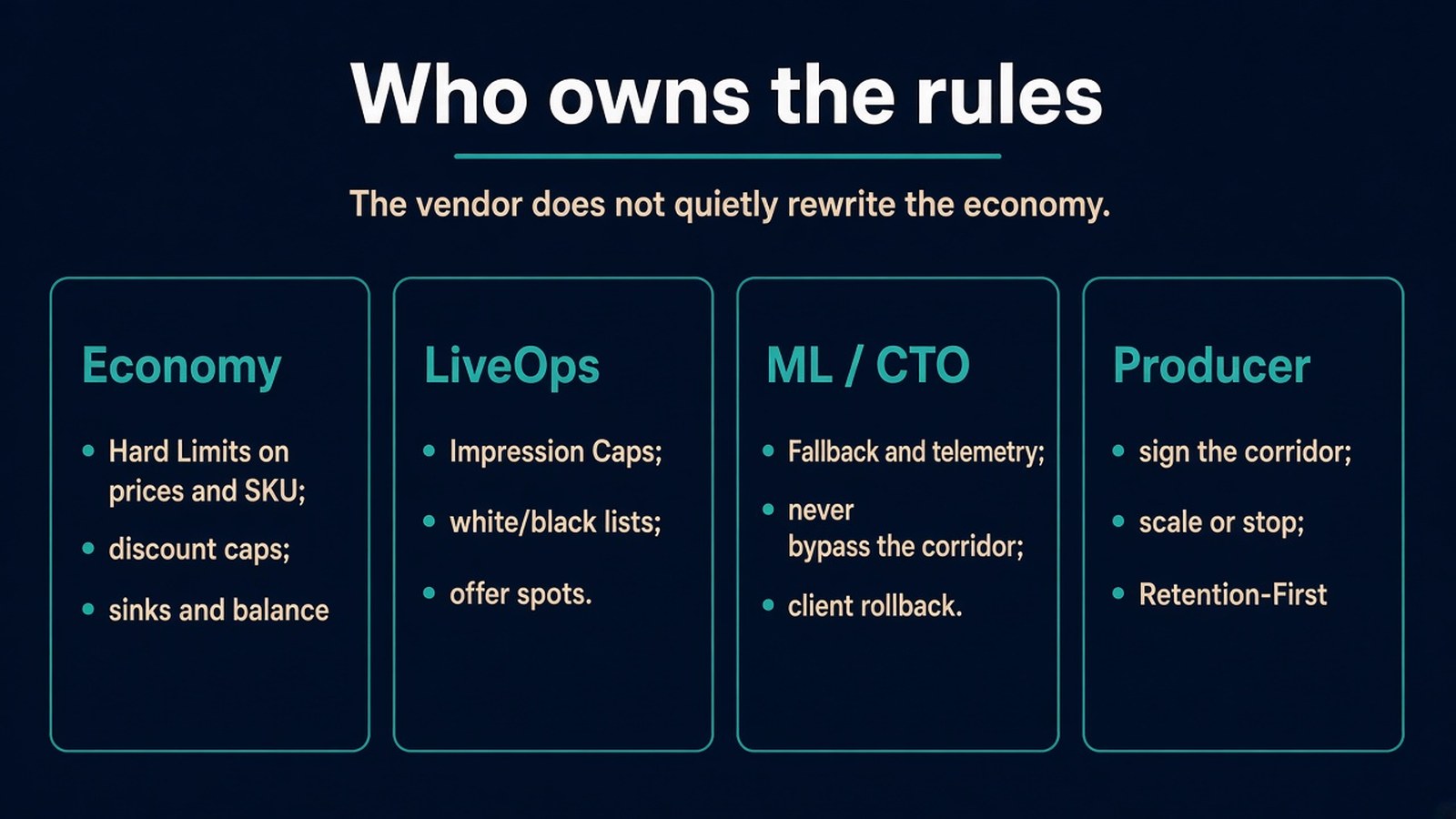
The corridor dies when “the vendor will set the limits” and nobody in the studio can name the rollback owner. Use this split. R = responsible for the work, A = accountable for the decision, C = consulted, I = informed.
| Role | Economy | LiveOps / monetization | CTO / ML | Producer |
|---|---|---|---|---|
| Price and discount Hard Limits | R (balance, sinks) | C (SKUs in the live shop) | I | A (signature) |
| White / black list | C (what breaks the meta) | R (spots and items) | C (what the client can show) | A |
| Impression Caps | I | R (caps and priority) | C (impression telemetry) | A |
| Fallback | I | C (default shop) | R (service silence → live UI) | A |
| Rollback | I | C (cohorts) | R (flag without resubmit) | A (when to press) |
| A/B and scale memo | C | C | C (assignment) | A (scale / iterate / stop) |
The solution vendor is R or C on SDK, the SandBox report, and issuance inside the rules. They are not A on the economy. If the vendor sits in the “sign the corridor” column, you have already confirmed the broken-economy objection.
Checklist (print it)
- Price Hard Limits are signed: min / base / max on SKUs in the pilot.
- Discount caps differ by cohort; panic after defeat is not a sale trigger.
- The white list is finite and assembled from the existing shop. The black list lives in the console, not Slack.
- Impression Caps per session and per player are set. Retention-First is a rule, not a slogan.
- Fallback is tested: when the model is silent the player sees the live default shop.
- Rollback without a client resubmit. A named on-call and a “minutes” clock.
- Event List mapped; session, purchase, fail, resource, and offer-show survive a build.
- If you will test, a baseline pack exists: ARPU/LTV, 1st Pay Conv., D7/D30, window, denominator.
- Traffic is not below 5,000 unique players per month for an ML pilot, or the cycle is explicitly “audit and corridor only.”
- The week-5 decision meeting is on the calendar before week-1 launch if you connect.
Takeaways
- AI proposes the offer. The studio holds prices, discounts, lists, frequency, Fallback, and rollback. Without a corridor, “the model will break the economy” is correct.
- Four levers live in one place the producer can read. An ML notebook is not a console.
- A discount without a cap teaches players to wait for a sale. Frequency without caps is scored spam.
- Fallback is a live shop in silence. Rollback that needs a build is not rollback.
- The corridor is an input to one experimental cycle, not a replacement for it. Scale still needs an A/B memo with D7/D30.
Ask for a SandBox, not a license
If you have roughly six months of events and a producer who can lock the corridor, the next step is a historical audit: segments, PJM, leaks, and a report you can hold next to the current stack. Start with the MONE audit / SandBox path or the pipeline. Studio console: dash.mone.tools. Analytics is a free layer; personalization billing, on the site, starts only after an A/B test confirms an ARPU lift.
Read next
- Player Journey Map for mobile games: how to turn the player path into a monetization tool
- From audit to scale: monetization personalization in one cycle
- How ML personalization works in mobile games: from events to offer choice
- How to connect a monetization personalization system to a mobile game