
Monetization and Game Difficulty: How Not to Turn Losses into Player Pressure
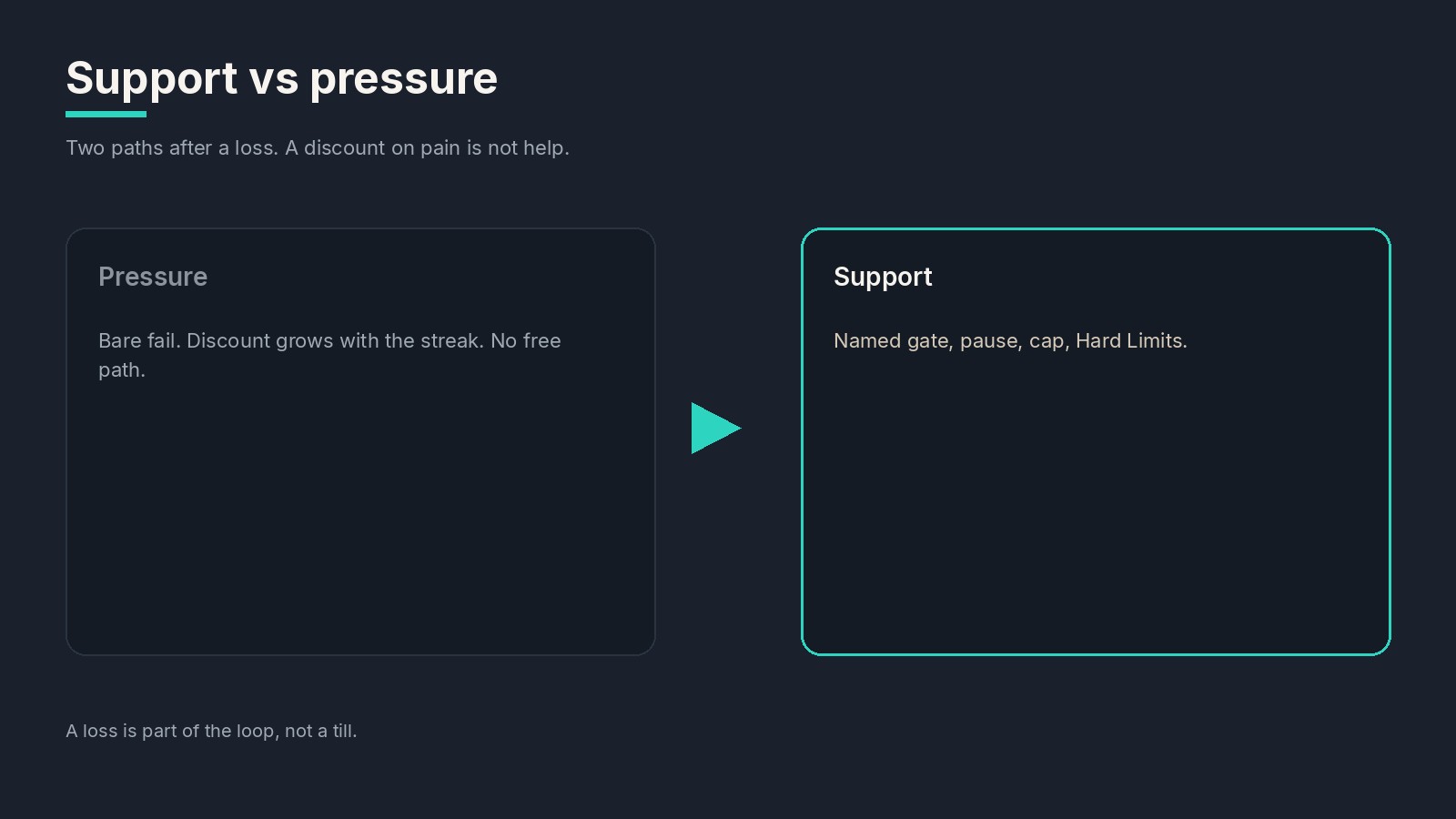
The producer sees ARPU move after a post-defeat offer and calls it “support.” The designer sees that after three fails in a row players leave and do not return on D1. The player sees something else: the game waits until it hurts, then sells the exit. Difficulty is not what broke. The sale moment broke: a loss becomes a till, not part of the loop.
Get sandboxThis is a MOFU brief for Game Designer, Level Designer, Producer, and LiveOps. You leave with a rule: an offer after a fail is a support corridor, not pressure. Timelines, the 5,000 unique players per month floor, and “analytics at $0” below are site claims from mone.tools, not a promise for your title. Do not treat unnamed genre cards as proven results.
What pressure actually is, versus support
Support after a loss is an offer that returns the player to a loop they already understand: attempt, resource, progress. Pressure is an offer that only makes sense because the player feels bad right now. The difference is not the SKU and not the size of the discount. The difference is whether you read a fail streak, a progress stop, and a resource as frustration signals or as a “hot lead.”
MONE describes a closed loop: collect data → read behavior on Player Journey Maps (PJM) → issue an offer inside designer rules → calibrate in an A/B test. A post-defeat offer answers a different question: may you show a purchase at the point where difficulty already hit, without turning difficulty into a paywall.
If the only trigger is `fail` or `defeat`, you train people to wait for a discount. Historical SandBox exists for this: six months of events can show where a fail streak precedes churn, and where it precedes an honest purchase after a meaningful session, while the analytics layer on the site is $0 (site claim). Connecting personalization makes sense when the designer can name the difficulty corridor and the producer can say which offer is banned inside it.
The site’s public pipeline (site claim): SandBox in 1–2 hours at the audit step, telemetry in 1–2 days, personalization launch in 2–3 days once Hard Limits and cohorts exist. Full personalization connection is less than a week (site claim). Those hours do not replace the meeting where design and monetization agree what “support after a loss” means.
Minimum for an ML personalization pilot on the site: 5,000 unique players per month. Below that floor the cycle is still useful — as an audit of frustration spots, not as a promise that the model will “save Retention with a discount.”
Three situations where a loss is not yet a till
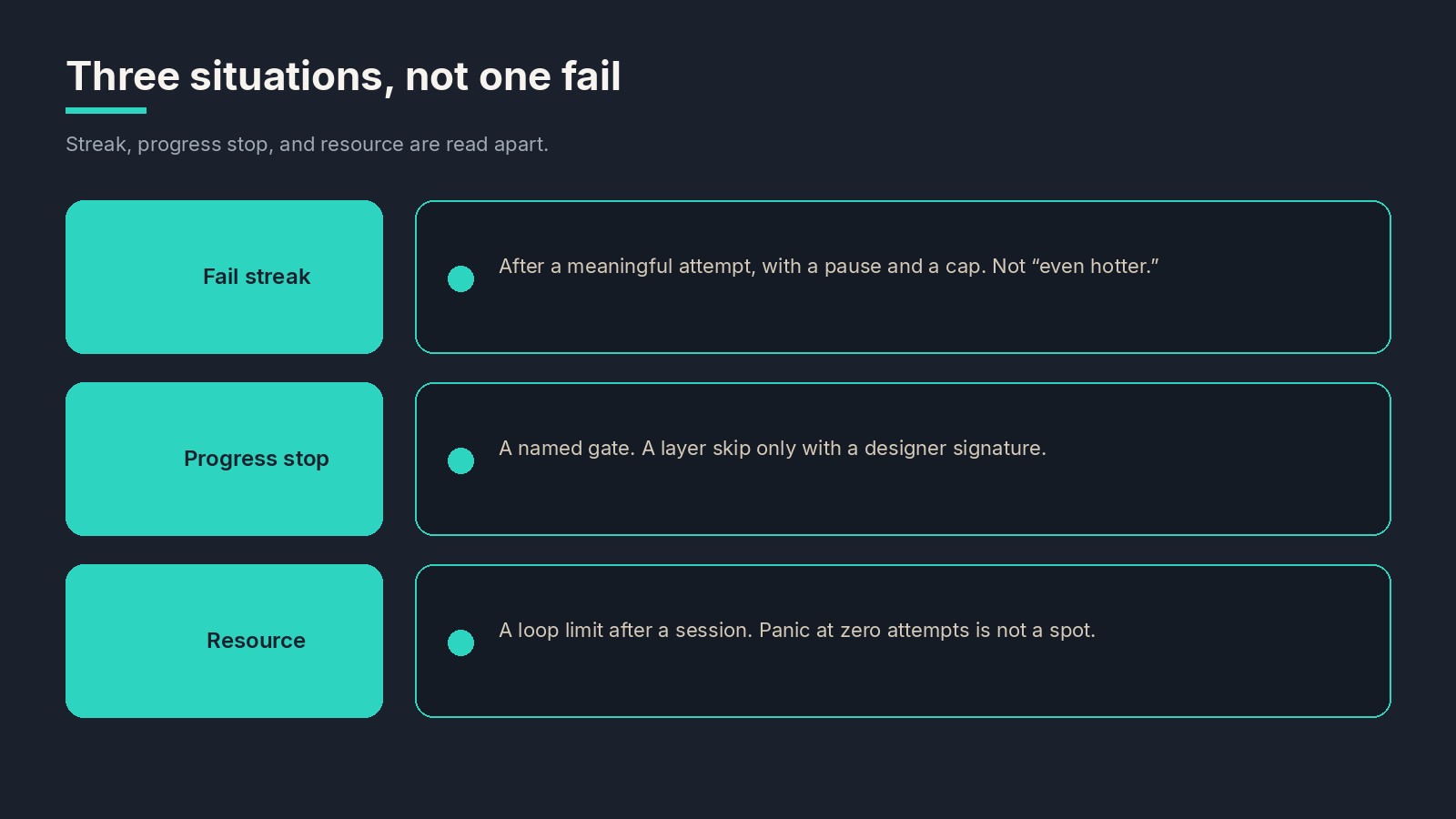
A situation is not “one more defeat event.” It is a place on the PJM where difficulty, progress, and resource meet. If you only see `fail`, you cannot tell a fair gate from a wall.
| Situation | Support if | Pressure if |
|---|---|---|
| Fail streak | After a meaningful attempt, with a pause and an impression cap | Right after 2–3 fails, discount grows with every fail |
| Progress stop | The player hit a named gate the designer treats as fair | The offer bypasses the gate and sells a “difficulty skip” |
| Resource | A design limit after a session, not panic | Energy/lives hit zero — and the paywall is immediate |
A fail streak is frustration, not intent
Two losses in a new layer and ten losses on the same boss are different signals. The first can be learning. The second is almost always frustration. An offer that appears only because the fail counter crossed a threshold trains the player: “wait until it gets worse — it will be cheaper.”
Lock:
- A streak threshold after which the offer is **banned**, not “even hotter.”
- A pause between the loss and the impression: the player can breathe; they do not buy in panic.
- An impression cap per session and per day. A fail streak does not lift the cap.
- Retention-First: a signal that lives only on fail does not enter first-purchase personalization.
A fail streak with no named gate is not “the player is ready to buy.” It is a player ready to leave.
Progress is a gate you do not sell in silence
A player who cannot clear a layer is not “not a whale yet.” They disagree with the difficulty. An offer that sells a skip of that layer changes the design: difficulty becomes a SKU. That is allowed only if the designer **named** the gate as paid and the economy around it does not depend on “everyone will buy because it hurts.”
Demand:
- A named PJM gate, not “any fail on level N.”
- An explicit answer: this gate can be bypassed by a purchase, or it cannot. Silence is pressure.
- A window after the stop: how many attempts you give before an offer, and how many before the difficulty is considered broken.
- A ban on substituting payment for progress in the metric: “they cleared it because they bought a boost” is not layer retention.
Resource is a loop limit, not panic at the till
Energy running out after a full session and lives running out on the third attempt of a tutorial boss are different economies. The first is intended rhythm. The second is the game taking the attempt before the player understood the rules, then selling it back.
Lock:
- Which currencies even enter a post-loss offer. Everything else is noise.
- A ban: resource-in-panic (zero attempts + a fail streak) does not raise the discount.
- The link to Hard Limits: a defeat does not widen the price corridor.
- An alternative to the purchase: a free path back into the loop — a different spot, a hint, a softer layer, not only a SKU.
When a post-loss offer is still honest
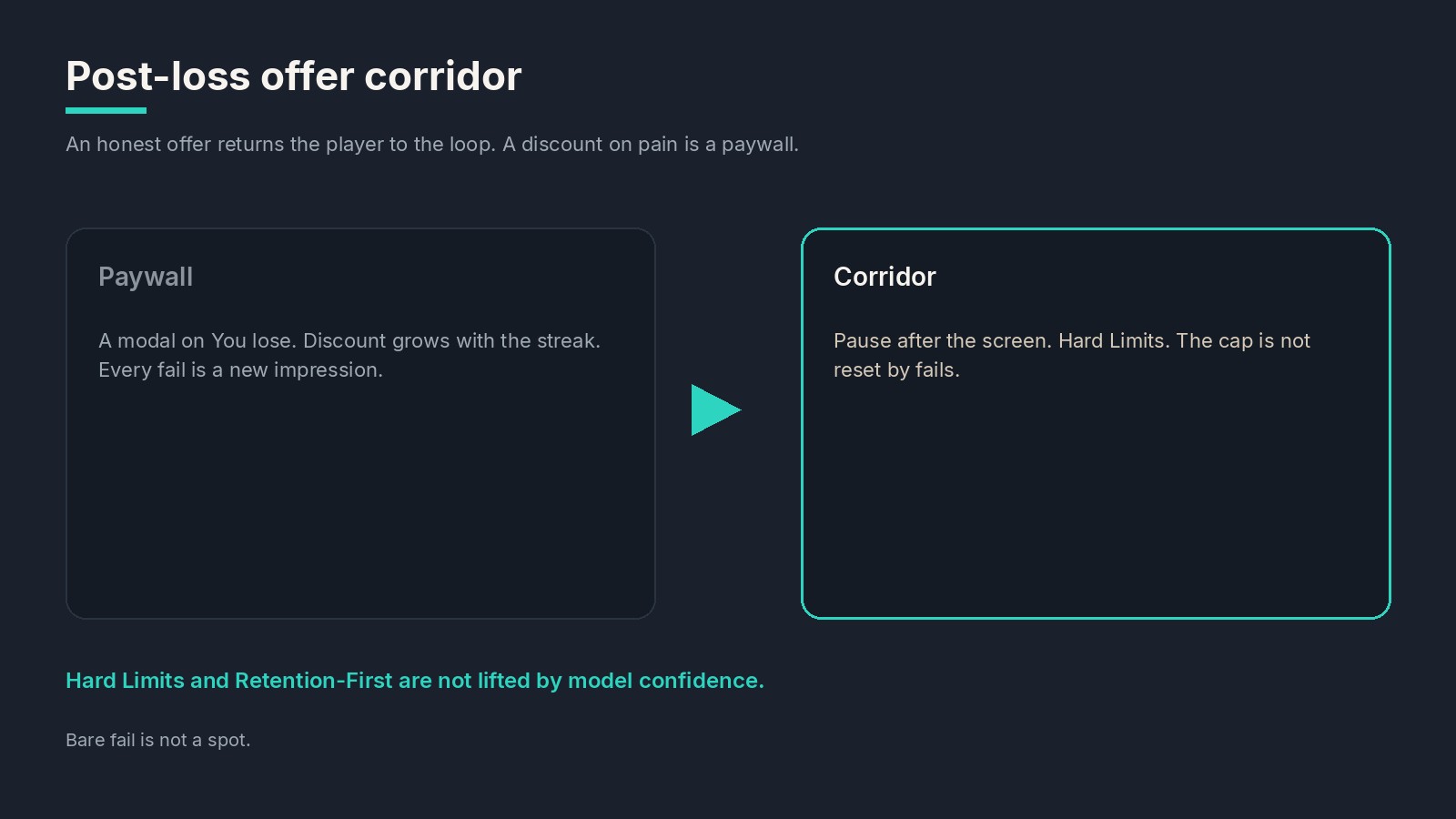
An honest offer at a difficulty point helps the player take the **next** meaningful step, not buy their way out of pain. It sits inside designer rules: white/black list SKU, discount ceiling, frequency, Fallback. AI that may show any pack on any fail is not personalization. It is a pressure machine with a confidence score.
| Rule | Allowed to show | Stop |
|---|---|---|
| Trigger | A named gate + resource after a session | Bare `fail` / `defeat` |
| Pause | After the defeat screen, not instead of it | A modal on top of “You lose” |
| Discount | A fixed Hard Limits corridor | Discount grows with streak length |
| Mix | What returns the player to the loop (attempt, layer key) | “Skip the whole act” with no designer signature |
| Frequency | Cap per session / day, not reset by fails | Every fail = a new impression |
A model with no corridor is a slide. Name which losses are **not** a spot, before the A/B. The site’s public window (site claim): 4 weeks of learning and measurement, then 3–5 days of evaluation. Do not mix that with “Sandbox in 48 hours” on the first screen — that is a different stage. Frustration spots can live on six months of SandBox history before you turn personalization on.
When this is still a paywall, not support
Name the red cell out loud before the D1 chart names it after you “tuned difficulty toward revenue.”
- The offer lives on `fail` and is issued as “help.”
- Discount or pack value grows with fail-streak length.
- There is no free path through the gate, only a SKU.
- The designer did not sign that this layer can be bypassed by a purchase.
- Success metric is only spot ARPU, with no D1/D7 of the cohort that saw the post-loss offer.
- Traffic is below the site floor, but the slide says “ML will remove frustration.”
- Privacy: the identifier is gone, and the “personal offer on the boss” is still user-level, not aggregate.
If any line is you, you are in a pressure-spot audit. That is what SandBox is for: see which losses even reach a decision, not buy a license early. On the site, personalization payment starts after confirmed ARPU uplift (site claim) — that is a commercial frame, not a reason to feed the model a fail streak as the only label.
Who holds the difficulty corridor, not “the model will figure it out”
The cycle dies when the post-loss offer is “for everyone” and for no one. Use a RACI-style split. R = does the work, A = owns the call, C = consulted, I = informed.
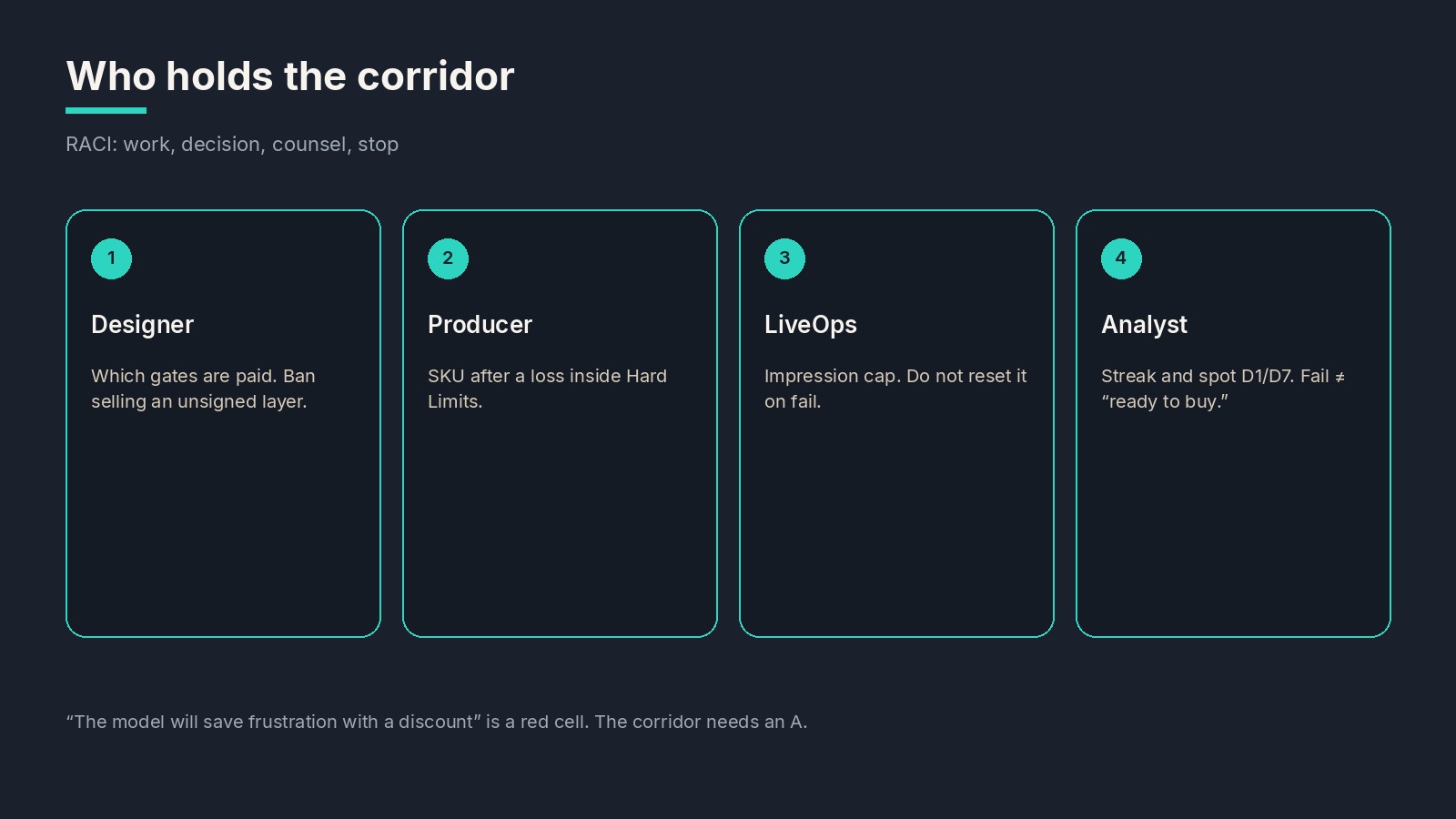
| Role | Corridor | Stop |
|---|---|---|
| Game / level designer | A: which gates are paid, which are not; what counts as fair difficulty | A: ban selling a skip of an unsigned layer |
| Producer | A: which SKU is visible after a loss inside Hard Limits | A: a fail streak does not widen the discount |
| LiveOps / economy | C: frequency, season, do not break live content | C: impression cap; do not reset it on fail |
| Analyst | R: streak, resource, D1/D7 of the spot cohort | R: do not train the model on fail as “ready to buy” |
| Vendor | C: comparable PJM cuts | I until the studio expands |
Checklist (print this)
- Three situations are named: streak, progress stop, resource. Bare `fail` is not a spot.
- After a loss there is a pause and a free path back into the loop, not only a SKU.
- Discount does not grow with streak length. Hard Limits and Retention-First stay on.
- The designer signed which gates can be bypassed by a purchase. Silence is a ban.
- Spot metric is not only ARPU, but D1/D7 of the cohort that saw the post-loss offer.
- The impression cap is not reset by a fail streak.
- The unique/month floor is named; below it — explicitly “pressure-spot audit only.”
- The corridor has an A. “The model will save frustration with a discount” is a red cell.
The point
- A loss is part of difficulty, not a till. An offer at that point either returns the player to the loop or trains them to wait for pain.
- A fail streak, a progress stop, and resource panic are three signals. Collapsing them into one `fail` is pressure.
- A discount that grows with fails, and a skip of an unsigned gate, break design faster than “dumb AI.”
- An honest offer sits in Hard Limits, with a pause and a cap. High model confidence does not lift a designer ban.
- SandBox can show frustration spots on history while analytics on the site is $0. Scale still needs a corridor, an A/B, and D7.
Ask for SandBox, not a license
If you have about six months of events and a designer who can name paid and free gates, the next step is a historical audit: where a fail streak precedes churn, where a post-loss offer feeds people who would have cleared anyway, which spots are still honest. Start from the MONE audit / SandBox path or from the pipeline. Studio console: dash.mone.tools. Analytics is the free layer; personalization payment, on the site, starts only after an A/B test confirms ARPU uplift.
Read also
- When to show an offer: 10 in-game situations where a proposal can be appropriate
- Dynamic offers in mobile games: how to match a proposal to a specific player
- How to keep control of the game economy when you use AI
- How to measure monetization’s effect on Retention: D1, D7, D30 and long-term LTV
- Player Journey Map for mobile games: how to turn the player path into a monetization tool